Aerial Yoga Apparel Engineering: Why Grip, Full Coverage and Seam Placement Requirements Are Unlike Any Other Movement Discipline
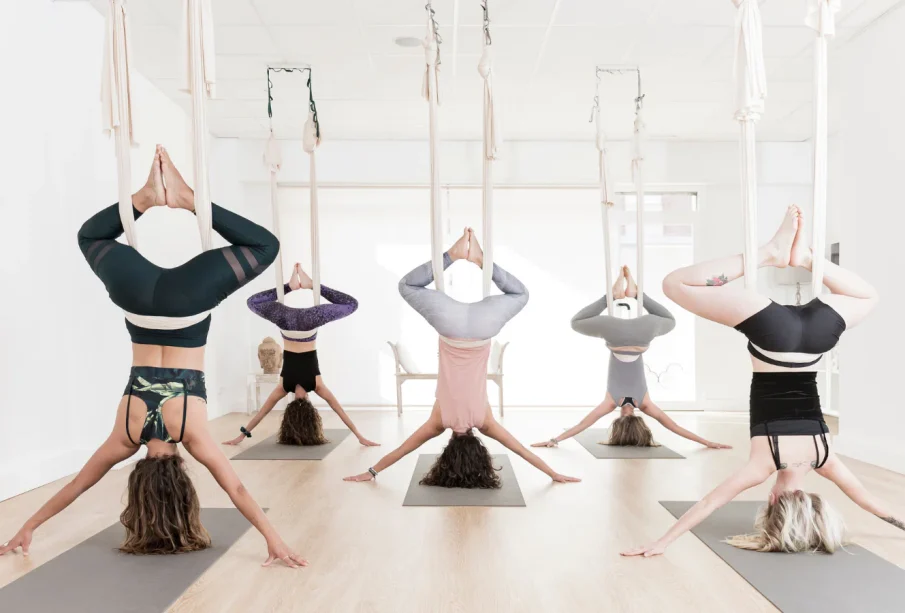
The apparel requirements of aerial yoga constitute one of the most technically specific clothing briefs in the entire activewear market. While most fitness disciplines create clothing requirements that are variations on a common theme of stretch, moisture management and support, aerial yoga imposes a set of demands that are genuinely unlike those of any floor-based practice and that produce specific design requirements which most general yoga or fitness apparel fails to meet adequately. The consequences of apparel failure in aerial yoga are more immediately apparent than in floor-based disciplines: fabric that slides on the silk hammock compromises grip on which safe posture depends, insufficient coverage creates skin contact issues with rigging hardware, and seam placement that is innocuous in floor practice becomes a significant discomfort source when the body’s full weight is supported by a narrow band of hammock fabric pressing against inadequately designed clothing construction.
The Grip Imperative: Where Aerial Apparel Diverges Most From Standard Yoga Wear
In mat yoga, grip between skin or fabric and the mat surface is desirable primarily to prevent sliding in challenging postures. The consequences of inadequate grip are typically postural imprecision or mild slipping that the practitioner can correct through repositioning. In aerial yoga, the grip between skin or fabric and the silk hammock fabric is a safety-relevant functional requirement, not merely a performance preference.
Many aerial yoga postures depend on friction between the practitioner’s skin or clothing and the hammock silk to maintain position. A back balance, where the body is arched backward over the hammock with the fabric running across the lower back, relies on the friction between the practitioner’s clothing or skin and the hammock silk to prevent the body from sliding backward out of position. A practitioner wearing smooth synthetic fabric in this position on a silk hammock that has been treated with any conditioning agent may experience significantly reduced friction that makes the position genuinely difficult to maintain safely.
The friction characteristics of the aerial hammock silk itself vary between studio environments. New silk hammocks have different surface properties from conditioned silk that has been used over many sessions and has accumulated trace amounts of the fabric conditioner that some studios use to maintain the silk’s longevity. The practitioner’s apparel must provide adequate grip across this range of surface conditions rather than only under optimal conditions.
The body surfaces that make contact with the hammock during aerial practice span a wider anatomical range than any floor-based practice: the inner thighs and hamstrings in inversions, the lower back in back balances, the tops of the feet in foot lock positions, the fronts of the ankles in various wrapping postures, the backs of the knees in seated aerial positions. Each of these contact surfaces has different grip requirements and different clothing coverage options that must be considered in aerial apparel design.
Coverage Requirements That Have No Equivalent in Ground-Based Practice
The coverage requirements of aerial yoga apparel extend to anatomical regions that most activewear designers have never considered as priority coverage areas, because the inverted and suspended positions of aerial practice expose skin surfaces that are never a coverage concern in upright or prone floor-based exercise.
The back of the knee joint, covered by the popliteal fossa, is one such area. In floor-based yoga, this region is rarely in direct contact with any surface under significant pressure. In aerial yoga, leg wrap positions where the hammock runs across the back of the knee create localised pressure on exactly this region. Smooth skin in direct contact with the hammock silk in this position is adequately comfortable for most practitioners. Leggings with bulky seams or decorative stitching that runs directly across the popliteal fossa create a pressure point that becomes increasingly uncomfortable over the duration of a posture hold. Leggings designed without reference to aerial use are frequently constructed with seams crossing this region without any consideration of overhead loading scenarios.
The hamstring surface, particularly the proximal portion near the sitting bones, experiences hammock contact pressure in seated aerial positions and in inversions where the hammock runs across the upper thigh. The sitting bone region is bony and has relatively little soft tissue padding, making it sensitive to concentrated pressure from narrow hammock contact areas. Activewear with thick seams or structural panels in this region significantly exacerbates the pressure discomfort, while smooth, flat-construction fabric in this area makes the same positions comfortable for extended hold durations.
The lower back and sacral region, which is the primary hammock contact surface in back balances and supported backbend positions, requires smooth, continuous fabric coverage that does not bunch, ride up or create pressure differentials across the hammock contact width. Short-cut tops that leave the lower back exposed in standing position are entirely inadequate for aerial practice: as the practitioner moves into back balance, the lower back skin makes direct contact with the hammock silk in ways that range from mildly uncomfortable to genuinely painful during extended holds, particularly on less conditioned silk.
Seam Architecture for Aerial Loads
The engineering of seams in aerial yoga apparel requires design consideration that is entirely absent from standard activewear construction briefs, because seams that are structurally adequate for the tensile and friction forces of ground-based exercise may concentrate pressure in anatomically sensitive areas under the compressive and distributed loading of aerial suspension.
The most problematic seam configurations in aerial yoga are those that run perpendicular to the long axis of the body in regions that make hammock contact under load. A seam running horizontally across the thigh, the calf or the lower back creates a ridge of doubled or reinforced fabric that, under the pressure of hammock contact with full body weight, concentrates the hammock’s contact force into a narrow band along the seam rather than distributing it across the full contact area of the fabric. This concentration of pressure is the mechanism behind the characteristic post-aerial bruising that many practitioners experience at the inner thigh and behind the knee: seam ridges concentrating contact force to a level that causes capillary disruption in the underlying tissue.
Flatlock seam construction, where the seam allowances are spread to either side of the stitch line rather than layered on top of each other, eliminates the ridge profile that causes pressure concentration and is the appropriate construction standard for all seams in regions of aerial hammock contact. Seamless construction, achieved through the circular knitting technology used in some technical activewear manufacturing, eliminates the seam contact issue entirely in the regions where it is used, at the cost of some design flexibility and manufacturing complexity.
The gusset construction at the crotch region requires specific attention in aerial apparel design. In aerial inversions, the structural integrity and comfort of the gusset is tested in ways that floor-based practice does not create. A gusset that is adequate for the tensile demands of deep lunges may be inadequate for the compressive and shear forces of inverted positions where the body’s weight is partially borne by the hammock contact with the pelvic region.
The Full-Length Requirement and Why It Is Non-Negotiable
One of the most consistent recommendations from experienced aerial yoga practitioners and teachers across Singapore’s aerial community is the requirement for full-length leggings rather than crops, shorts or any lower body garment that leaves the calves, ankles or shins uncovered.
The practical basis for this recommendation is the ankle and shin contact that numerous aerial postures require. Foot lock positions, where the hammock wraps around the ankle and lower shin to create a secure contact point for inverted positions, place the hammock silk in direct contact with the front of the ankle and the lower shin under full body weight. Uncovered skin in this region experiences significant friction and pressure during these postures that accumulates into the raw, irritated patches that characterise the aerial learning period for practitioners who attend in crops or shorts.
Full-length coverage in smooth, flat-seam construction fabric eliminates this issue by providing a consistently lubricated interface between the hammock silk and the body surface, distributing the contact forces across the full fabric area rather than concentrating them against bare skin.
Yoga Edition serves an aerial yoga community that has progressed beyond the initial learning period and whose practice sophistication extends into the details of how their apparel choices affect the quality, comfort and safety of their practice, reflecting the broader principle that serious aerial practice deserves equipment and apparel that are genuinely engineered for its specific demands.